Solutions · Universities
University management system: what AcademicsFlow covers, and what it does not
A university management system runs a university's administration: admissions, student records, course registration, timetables, fees, staff and reporting. AcademicsFlow is built around classes, a weekly timetable, registers and term reports, so it does not cover credit hours, semester course registration or transcripts across programmes today. It can run class-based programmes and fee and staff administration, and we will say plainly whether the rest could be built.
- Class-based programmes
- Fees and staff administration
- Honest scoping before you commit
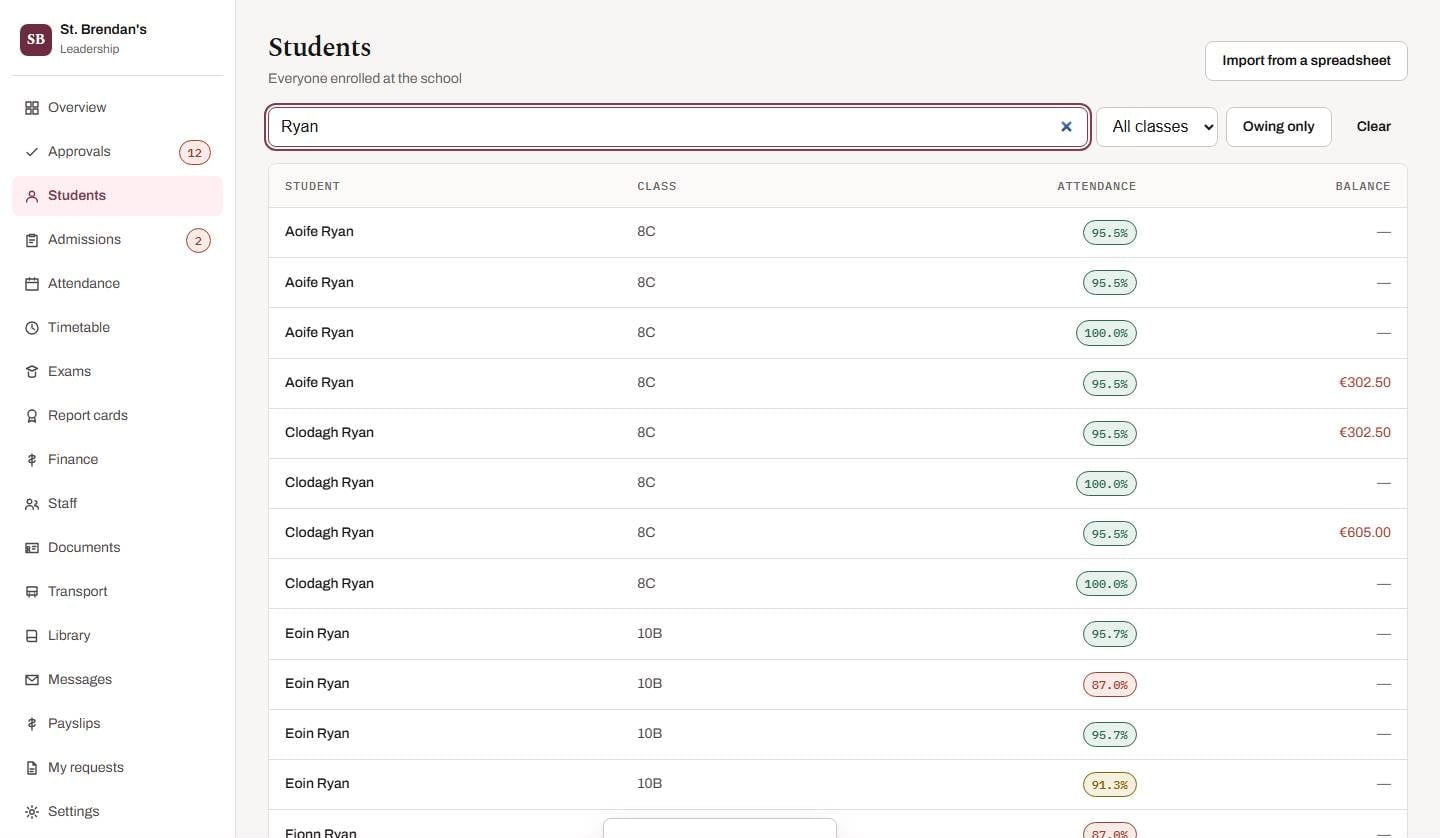
What it does
What it covers for class-based programmes.
What is a university management system?
A university management system is software that handles the administration of a university in one connected system. It usually combines a student information system for records with the finance, staff and operations functions of an education ERP, and it often sits beside a learning management system used for teaching.
What sets it apart from school software is how study is organised. A university student typically builds a programme from individual courses, earns credit for each, and is assessed by semester or term. Records follow the student across courses and years, and the registry issues transcripts.
How do universities manage student records?
Most universities keep one record per student that lasts the whole of their time there. The registry maintains it, and departments contribute to it. The core of that process looks like this:
- Admission. An applicant is assessed, and an accepted applicant becomes a student with a unique identifier.
- Registration. Each term the student registers for courses, within the rules of their programme.
- Teaching and attendance. Staff teach the registered students, and some courses record attendance.
- Assessment. Marks are recorded against each course and combined under the programme's grading rules.
- Progression and awards. The registry checks progress and credit, and confers the award.
- Transcripts. The record is issued on request as an official statement of courses and results.
Access matters as much as the steps. A department should see its own students, the finance office should see balances and the student should see their own record, which is why role-based access enforced on the server is a basic requirement.
Which university needs does AcademicsFlow cover?
| University need | Standard product today | Notes |
|---|---|---|
| Applications and admissions | Covered | Public form, review pipeline, offers and one-click enrolment. See admissions. |
| Student records and guardians | Covered | Contacts, documents and role-scoped access. See student information system. |
| Attendance | Covered | Registers by class and lesson, with offline capture. |
| Timetable by class, teacher or room | Covered | Clashes refused. Automatic timetable generation is not included. |
| Fees and online payment | Covered | Invoices, a hosted checkout and reconciliation. See fee management software. |
| Staff, leave and payroll | Covered | Payroll tax rules are configured per country. |
| Certificates and ID cards | Covered | Numbered and recorded, with signed QR codes on cards. |
| Course registration by student choice | Not in the standard product | Ask us. It would be custom development. |
| Credit hours, semesters and GPA | Not in the standard product | Grading scales such as GPA can be built as custom development. |
| Transcripts across programmes | Not in the standard product | Ask us. It depends on how your programmes are structured. |
| Teaching content, quizzes and forums | Not included | AcademicsFlow is not a full LMS. See learning management system. |
Where might AcademicsFlow fit inside a university?
Parts of a university often run on the same model as a school: a fixed cohort, a weekly timetable, registers and term reports. Examples include a foundation or pathway year, an affiliated school, a language centre or a short-course programme. For those, the standard product is a reasonable starting point, and a demo on your own structure will show quickly whether it holds.
Other parts are about administration rather than study. Fee collection, staff leave and payroll, and certificates are the same problems in a university as in a school, and a department may want them while the registry keeps its own student system. AcademicsFlow exposes a documented REST API for connecting to other systems, and integrations are quoted separately.
How would a university project be scoped?
- Tell us how you are organised: programmes, how students register, how results and transcripts work, and how many students are involved.
- We answer plainly. For each need, we say whether the standard product covers it, whether it is custom development, or whether it is not a fit.
- You see the standard product on a populated sample school, so you judge it on real screens.
- Custom work is quoted separately on the custom development page's terms, with a fixed scope before anything starts.
- Pilot one programme before committing the institution.
Subscriptions are $0.40 per enrolled student per month when billed yearly. Beyond 5,000 students, which most universities exceed, talk to us for a quote that suits your size.
In the product
Real screens, not mock-ups.
Every image is the running product on a sample school.
- AcademicsFlow
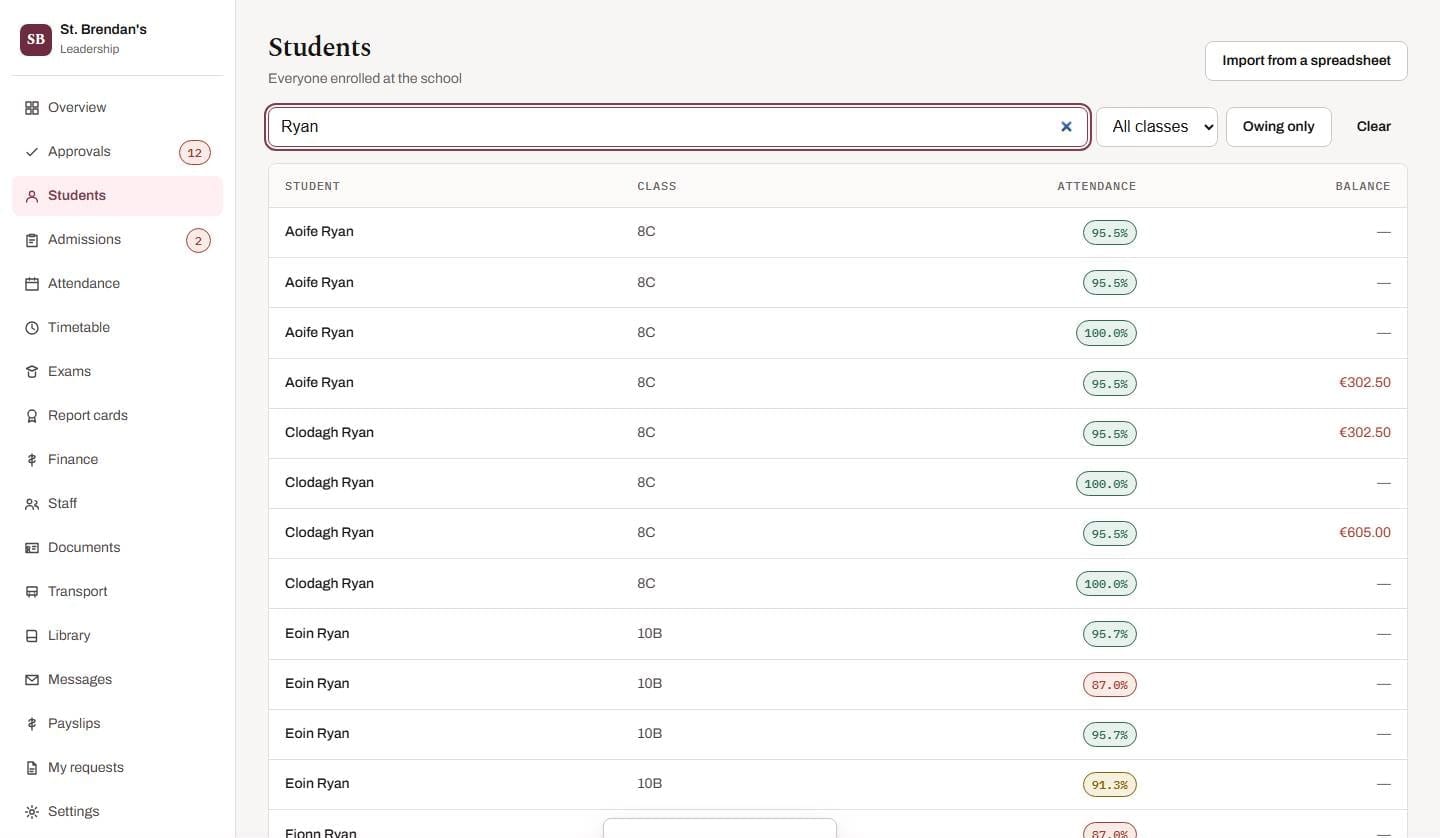
Searchable student lists, scoped on the server to what each role may see. - AcademicsFlow
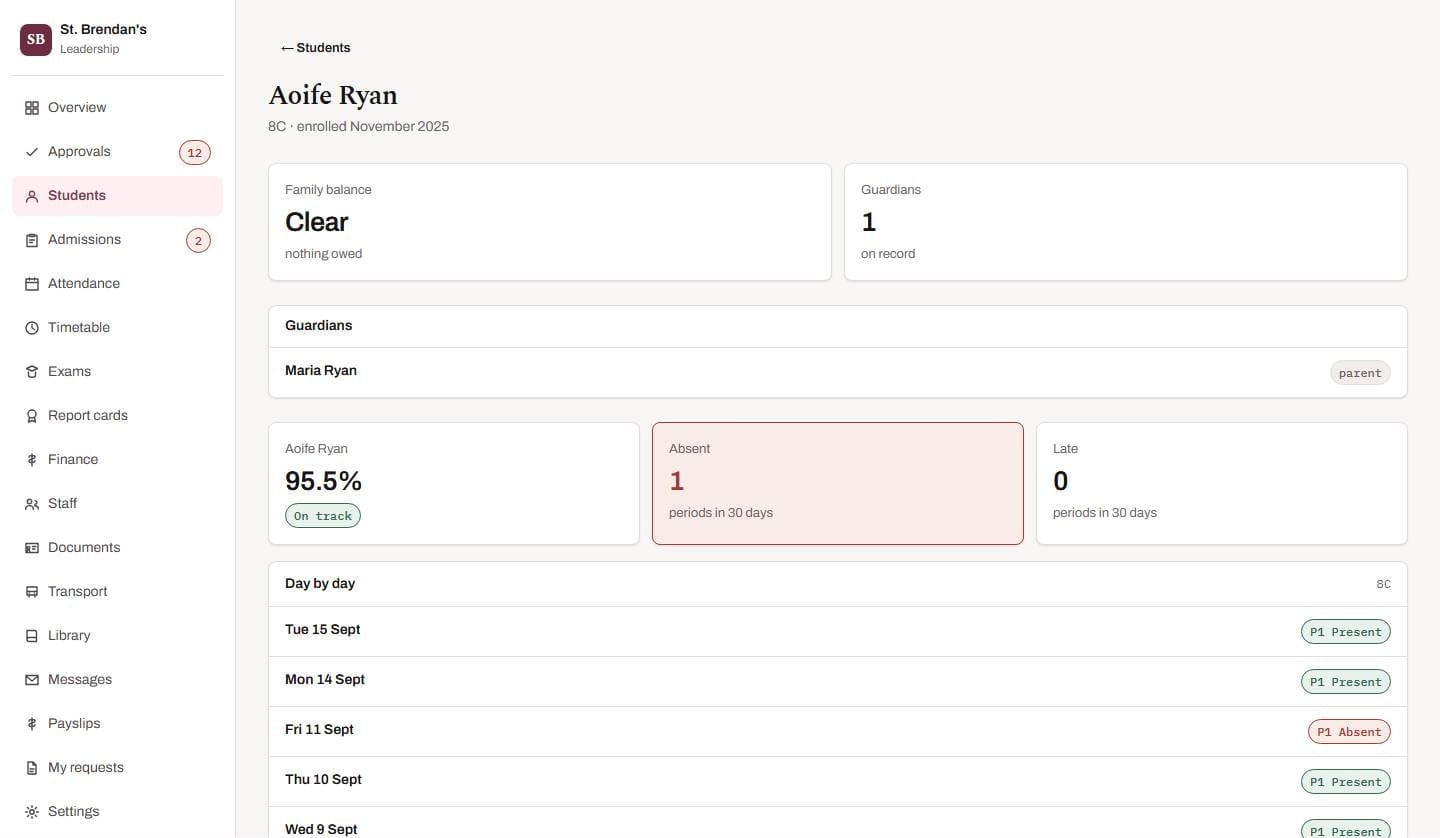
One record shows attendance, balance and contacts together. - AcademicsFlow
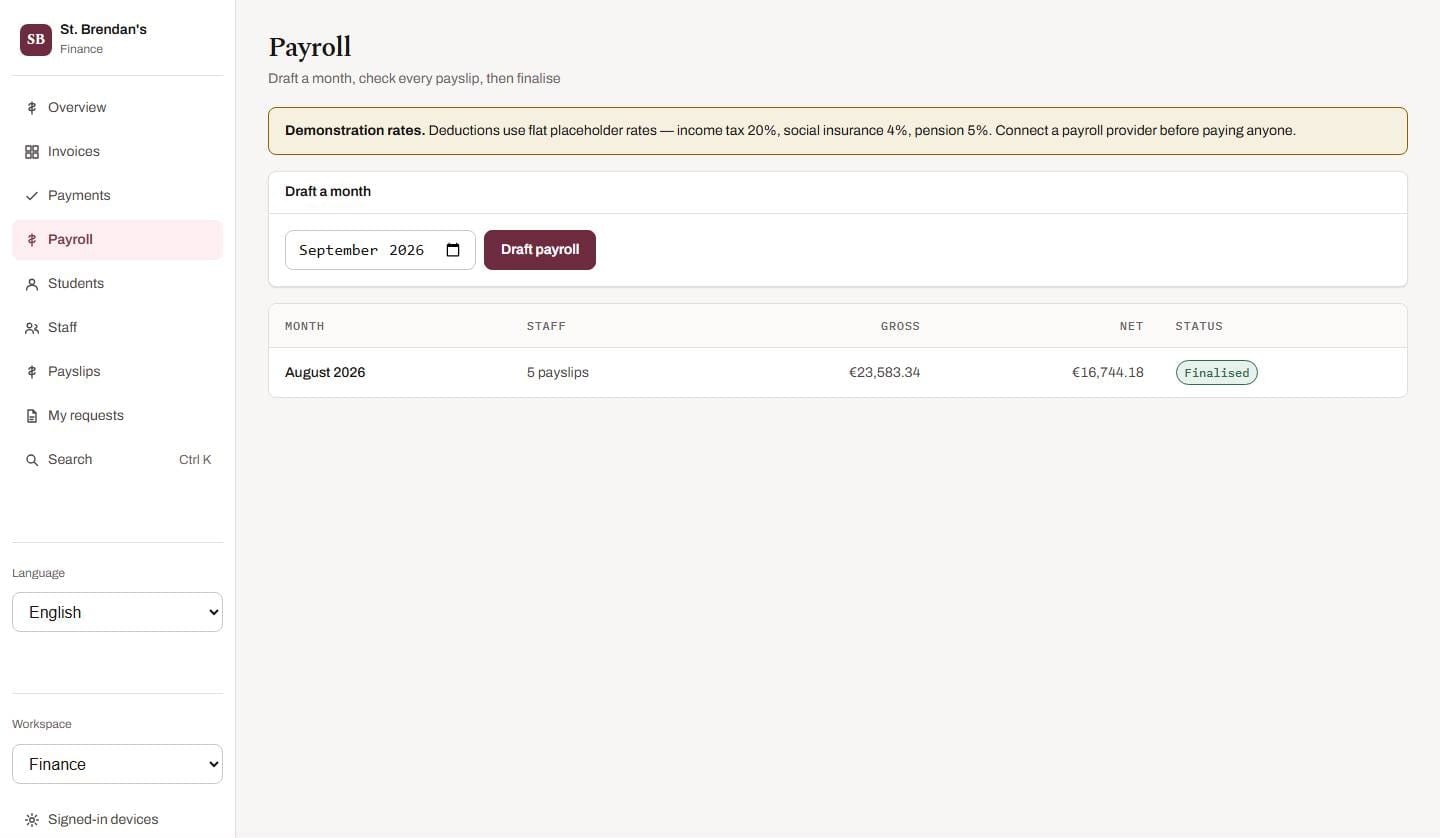
Staff payroll: draft a month, check every payslip, then finalise on purpose.
Who benefits
One system, a different view for each person.
Registry and administration
Run applications, records, documents and approvals for class-based programmes from one system, with role-scoped access enforced by the server.
Teaching staff
Take registers from the timetable, set and mark coursework, and see only the students your role allows.
Students
See your timetable, hand in work and read feedback on the web today.
Finance and HR teams
Invoice and reconcile fees, approve waivers, manage leave and run monthly payroll with guard-rails.
Examples
What it looks like in practice.
Illustrative scenarios built from how the product works. They are not customer stories.
A foundation year with a fixed cohort
The situation
A university runs a one-year foundation programme for a single cohort, with a weekly timetable, registers and termly reports.
How AcademicsFlow helps
This is the model AcademicsFlow is built around. Applications, enrolment, registers, coursework, reports and fees all run in one system for the cohort.
An affiliated school or language centre
The situation
A university operates a school or a language centre on its campus, with its own pupils, timetable and fees.
How AcademicsFlow helps
It can use the product as a school would, with its own staff, families and fee collection, while the university's main student system stays separate.
Fees and payroll for a department
The situation
A department wants better fee collection and staff administration but must keep the registry's course system.
How AcademicsFlow helps
Fees and finance and staff and payroll can be used on their own terms, and a REST API integration, quoted separately, can connect the two systems.
What is not part of the standard product
A university needs more than a school does. These parts do not exist in the standard product today.
- Course registration where students choose individual courses.
- Credit hours, semester structures and degree progression rules.
- Official transcripts across programmes.
- A full learning management system for teaching content, quizzes and forums.
- Automatic timetable generation for large course catalogues.
- Certifications such as SOC 2 or ISO 27001. AcademicsFlow does not hold them and does not claim to.
What is inside
The modules behind it.
Staff, Leave & Payroll
A private staff directory, leave that checks itself, and payroll you finalise on purpose.
Frequently asked questions
What is a university management system?
A university management system is software that runs a university's administration: admissions, student records, course registration, timetables, assessment and transcripts, fees, staff and reporting.
How do universities manage student records?
They keep one record per student for their whole time at the university. The registry maintains it through admission, course registration each term, assessment, progression and awards, and issues transcripts from it. Access is role-based, so departments, finance and students each see only what they should.
Is AcademicsFlow a complete university management system?
No. It does not cover course registration, credit hours, semesters or transcripts across programmes. It does cover applications, records, timetables, attendance, fees, staff and payroll for class-based programmes.
Can a university use AcademicsFlow for part of its work?
Possibly. Class-based programmes such as a foundation year, and administrative needs such as fee collection and payroll, are the likeliest fit. Tell us how you are organised and we will say plainly what fits.
Can the missing parts be built?
Some can, as custom development, and we will say which before any work starts. Course registration, GPA scales and integrations with your existing systems are the usual requests. Others, such as a full LMS, are better handled by connecting a product built for that.
How is a university priced?
Subscriptions are priced per enrolled student, in blocks of 100. For more than 5,000 students, or where custom work is involved, we quote for your size and scope.
Keep exploring
- College Management SoftwareFor colleges that run on classes, a weekly timetable, registers and term reports.
- Student Information SystemThe system of record for enrolment, guardians, attendance and grades.
- Education ERP SoftwareStudents, finance, staff, transport and the library in one connected system.
- Learning Management SystemHow an LMS differs from school software, and what AcademicsFlow covers for coursework.
Related reading
See AcademicsFlow running a school like yours.
Book a live walkthrough with a fully populated sample school — or tell us what you need and we'll put together a proposal.
Prefer email? info@academicsflow.com